Thursday, December 26, 2013

Gatchaman Review


JAPANESE FILM FESTIVAL: Back when I was in primary school, I used to watch the cartoon series Battle of the Planets. I liked it well enough, though would hesitate to call myself a diehard fan. And while I knew nothing of its origins—that it was, in fact, an American-dubbed version of a Japanese anime franchise, Science Ninja Team Gatchaman—I do recall wondering why Mark, the handsome, white-clad leader of G-Force, sounded exactly like Shaggy from Scooby-Doo (answer: they were both voiced by American Top 40 DJ Casey Kasem), and why their robot sidekick, 7-Zark-7—a pretty obvious R2D2 rip-off—was such a tool.

Back in its homeland, though, the show was a phenomenon, spawning a slew of TV sequels and an animated movie. Yet a live-action version, long mooted, never materialised. (About a decade ago, a Hong Kong-based production began shooting, but was never completed.) Now, at last, there’s a feature film, made by Nikkatsu and shot entirely in Japan. The momentousness of this pop-cultural moment cannot be underestimated.


Mary Meets Mohammad Review

Pontville is a tiny inland hamlet, a short drive from Hobart. Nestled amongst a setting of gentle hills and paddocks, it has a sleepy grey beauty, and it seems a long way from anywhere. Still, as this new feature documentary from debut filmmaker and occasional journalist Heather Kirkpatrick would have it, what happened in Pontville over the last couple of years became a kind of real-world test case for a national debate. Which is to say that Mary and Mohammad is a movie that assays the asylum seeker/mandatory dentition policy controversy. It can’t be mistaken as anything but an advocate’s film; throughout Kirkpatrick uses the paintings of Ghulam Sakhi Hazara, an Afghan refugee once detained at Portland. They are nightmarish images of cells and wire and they yearn for escape. But any casual expectation that it’s an angry rant is dispelled pretty quickly by its quiet, observational style and its homemade, hand-crafted feel. This is a movie that makes a plea for understanding and it uses a story of a kind of spiritual conversion to do it.

The Counsellor Review

There were key moments in Ridley Scott’s The Counsellor where I caught myself leaning towards the screen, determined not to miss a shimmering, steely frame of Dariusz Wolski’s camera work or a single syllable of Cormac McCarthy’s lithe script. Such a response would suggest that I was compelled by the shady doings of the A-plus-plus cast. All strive determinedly to realise the story of a nameless, arrogant lawyer (Michael Fassbender) who risks all that is precious to him (mostly Penelope Cruz’s Laura, his love) to be part of a get-rich-quick, one-off cocaine smuggling swindle.

But I was not on the edge of my seat because I was thrilled by any element of the film. Rather, it was out of sheer bewilderment that this gaggle of talents had forged one of the most pretentious, infuriating and nonsensical studio works in some time. The Counsellor is a train wreck of a film, the likes of which I haven’t seen in quite some time.

Films that are so front-loaded with talent often only get financing when a swag of Oscars and box-office hits are attached to the team. In addition to Scott and McCarthy (penning his first stand-alone screenplay), key players include Javier Bardem as a flamboyant nightclub owner Jiminy Cricket-ing our protagonist, Brad Pitt as an ice-cold middle man, and Cameron Diaz as a venomous femme fatale who likes watching her pet cheetahs kill jack-rabbits and is seen masturbating against a windshield to prove her worth as a crime kingpin’s main squeeze.

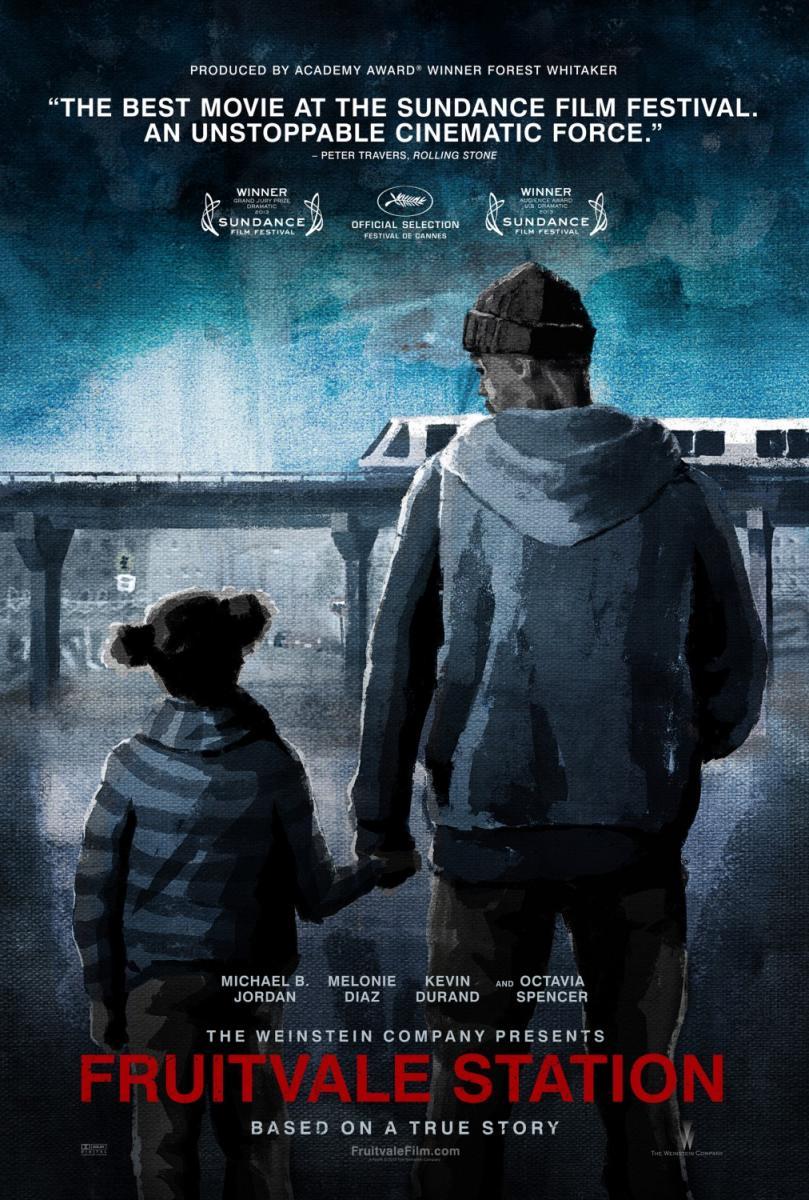
Fruitvale Station Review

‘Fruitvale’ is the name of a train stop in San Francisco that became synonymous with police brutality and racial profiling, when a deadly incident occurred there in the early hours of new year 2009. A white transit police officer shot a handcuffed black man in the back, whilst simultaneously pinning him, face-down, to the platform. Twenty-two-year-old Oscar Grant later died of his injuries and the officer received a reduced conviction, claiming he mistook his gun for his taser.

It was 2009 so, from the moment the officer singled out Grant and his friends on the train, a number of commuters responded to the instincts inherent to all smartphone owners, and recorded what they saw. They later handed over their clips to investigators and put the material in the public domain. The YouTube footage went viral (I remember seeing it in my Facebook feed at the time) and sparked online outrage, though it effected little change from a social justice perspective (case in point: it was three years before Trayvon Martin walked through a Florida gated community in a hoodie).

This preamble is intended to give context to Fruitvale Station, Ryan Coogler’s debut feature film on the subject, which itself is a kind of foreword to those events. If you’re after a burning polemic about police oppression or a miscarriage of justice, Coogler’s small film will surely disappoint. (The case and its outcome is only mentioned in postscript.) Fruitvale Station is more an affectionate parable of missed opportunity, intended to round out the picture of Oscar Grant that his status as a tragic statistic denies him.

Closed Circuit Review

On the website of its American distributor, the page dedicated to Irish Director John Crowley’s surveillance-themed conspiracy thriller Closed Circuit does the film no favours by reminding visitors of noteworthy films in the same genre, including The Parallax View, Blow Out, Enemy of the State and The Lives of Others. Re-watching any of these for that all-important paranoia fix will be vastly more rewarding than spending time and money on this unfocused and surprising lethargic enterprise.

Six months after a truck bomb destroys a popular downtown London marketplace, the government is preparing to prosecute Farroukh Erdogan (German-born Italian-Turkish actor Denis Moschitto) for the crime even as he steadfastly maintains his innocence. When the defence attorney is found dead of an apparent suicide, barrister Martin Rose (Eric Bana) is brought on to the team that already includes his ex-lover Claudia Simmons-Howe (Rebecca Hall) by the politically crafty Attorney General (Jim Broadbent).

They recognise the importance to their careers of the case and decide to cover up their previous relationship. Whilst Simmons-Howe awaits secret evidence the government will release for her eyes only, Rose begins to make disturbing discoveries that suggest there’s more to Erdogan than he lets on. Naturally, this information places both of their lives at risk and leads to revelations of skullduggery and moral rot at the highest levels.

Night Train to Lisbon Review

Amid the more colloquial levels of film-crit discourse (where the word ‘Canadian’ is strictly an adjective, capable of evoking entire volumes of worthy tedium), there is a particular phenomenon known as the Euro-Pudding. It’s easily identifiable, and readily comprehensible, a function of expediency rather than inspiration. Its provenance is vague—a little German money here, some French tax credits there, perhaps an available soundstage in Romania... Its locations are top-notch; likewise its production design. The cast are a mixture of either second-tier or down-on-their-luck veterans, and fresh-faced young unknowns, all drawn from many lands. And everyone speaks English.

Based on a novel by Pascal Mercier, this is one of those, a throwback to a pre-EU age of international co-productions. The pacing is stately, and the storytelling static and talky; its director, Danish veteran Bille August—a onetime Foreign Language Oscar winner (for 1989’s Pelle the Conqueror)—is very much a craftsman of the old school. Yet the flipside of this is a robust sort of professionalism. The music is tasteful, and the surface unfailingly elegant. The camera is dependably where it ought to be. It’s not exciting in the least, but it is handsomely-made, and for older generations of filmgoers, longing for something devoid of superheroes or teenage warriors, something that reeks of Quality Drama, it may prove an enticing proposition.

The Spectacular Now Review

Asked why his films so often dealt with the romantic travails of  people much younger than himself, French auteur Eric Rohmer noted that the passions of youth were deeper, and therefore more worthy of scrutiny, than those of maturity. It’s a lesson that recent American cinema seems to have taken to heart. While the multiplexes overflow with films either pandering to adolescence (the Marvel and Twilight franchises) or valorising its potency (The Hunger Games, Ender’s Game, the forthcoming Divergent), a small brace of studio-indie flicks have examined this ‘difficult age’ with honesty as well as tender affection. The Perks of Being a Wallflower was one of last year’s best movies; The Spectacular Now (based, like that one, on a popular young adult novel) is no less remarkable.

Sutter is a charming underachiever—none too bright, perhaps, but unfailingly good-humoured, and popular enough to coast through his senior year of high school. Drifting from one backyard party to the next, he has no particular ambition beyond the next keg of beer. His girlfriend Cassidy, however, sees him for the budding alcoholic he is, and ends their relationship—which only serves to plunge him into an anguished, week-long bender, complete with blackouts. He wakes from one of these on a stranger’s lawn; looking down at him with fretful concern is Aimee, a plain, slightly geeky suburban girl. And at once, Sutter is smitten...

Kill Your Darlings Review

Allen Ginsberg (Daniel Radcliffe) never killed anyone, but once upon a time he knew someone who did and this human tragedy broke his heart and opened his soul to all kinds of possibilities, cerebral and sensual, artistic and political. At least that’s the pitch for this ambitious low budget indie, the directorial debut of American John Krokidas.

The killer Ginsberg once knew was Lucien Carr (Dane DeHaan), who was ultimately charged with manslaughter over the death of David Kammerer (Michael C. Hall). The press accounts at the time, urged by Carr’s defense, depicted this ugly scene as a innocent young straight man defending himself against the unwanted attentions of an older predatory homosexual. Carr served a little time and died a free man, a family guy who found a career in the mainstream of journalism at the UPI agency. Ginsberg later dedicated his seminal book of poetry ‘Howl’ to Carr and Carr asked to have his name removed. The death of Kammerer was buried as an historical footnote, its details a murky wash of stern court records, and claim and counter-claim.


The Gilded Cage Review

Ruben Alves blends his Portuguese family’s backstory into the warm – if a little weird – French farce, The Gilded Cage.

This story of the Portuguese diaspora focuses on an apartment block in Paris, where Maria Ribeiro (Rita Blanco) toils as the on-site concierge, politely beholden to- and perennially on call for- the entitled residents on the floors above. Her husband José (Joaquim de Almeida) does the odd jobs and maintenance, whilst also being the trusted foreman of an over-committed construction company (his personable manner is an acknowledged asset when his employer is negotiating much-needed mega-Euro contracts).

Alves establishes early on that José and Maria are indispensable to everyone they know, as they smilingly tolerate each new claim to their time; truth be told, they rather enjoy the feeling of being needed by all and sundry, including by their extended families (Maria's sister Lourdes, for instance, dreams of opening a café serving Portuguese delicacies, but her success rest on culinary wiz Maria stepping up to the hot plate). Having moved to France for a better life several decades ago, Maria and José identify with the lot of hard-working, self-sacrificing émigré, down to the fact their kids now identify more as French than Portuguese.

American Hustle Review

There are some moviegoers who avoid reading anything about a film before they see it. Others are sensitive to the relatively recent and short-sighted phenomenon known as “spoilers,” learning plot details or twists in advance. The more militant even avoid coming attractions trailers altogether, going so far as to turn away from televisions and time theatre entrance around them.

Those counting themselves amongst any or all of those camps may want to avoid even looking at photographs from director and co-writer David O. Russell’s fast-paced and very funny con movie American Hustle prior to viewing. Between the outlandish hairstyles and the garish clothes, the pictures suggest an awkward and overly exaggerated 1970s period movie.

Nothing could be further from the truth. Well, it is a 1970s period piece, but so convincingly does Christian Bale cuddle under his gravity-defying comb-over, so relaxed is Bradley Cooper in his clenched permanent (even shown in one scene sporting pink curlers) and with such aplomb does Amy Adams wear those plunging necklines that, rather than take one out of the picture, the Me-Decade trappings actually enhance the experience. In fact, one colleague at a recent press show had no idea Bale was the lead until the credits rolled.