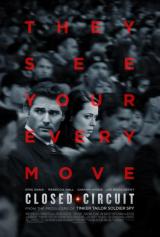
 On the website of its American distributor, the page dedicated to Irish
Director John Crowley’s surveillance-themed conspiracy thriller Closed Circuit does the film no favours by reminding visitors of noteworthy films in the same genre, including The Parallax View, Blow Out, Enemy of the State and The Lives of Others.
Re-watching any of these for that all-important paranoia fix will be
vastly more rewarding than spending time and money on this unfocused and
surprising lethargic enterprise.
On the website of its American distributor, the page dedicated to Irish
Director John Crowley’s surveillance-themed conspiracy thriller Closed Circuit does the film no favours by reminding visitors of noteworthy films in the same genre, including The Parallax View, Blow Out, Enemy of the State and The Lives of Others.
Re-watching any of these for that all-important paranoia fix will be
vastly more rewarding than spending time and money on this unfocused and
surprising lethargic enterprise.Six months after a truck bomb destroys a popular downtown London marketplace, the government is preparing to prosecute Farroukh Erdogan (German-born Italian-Turkish actor Denis Moschitto) for the crime even as he steadfastly maintains his innocence. When the defence attorney is found dead of an apparent suicide, barrister Martin Rose (Eric Bana) is brought on to the team that already includes his ex-lover Claudia Simmons-Howe (Rebecca Hall) by the politically crafty Attorney General (Jim Broadbent).
They
recognise the importance to their careers of the case and decide to
cover up their previous relationship. Whilst Simmons-Howe awaits secret
evidence the government will release for her eyes only, Rose begins to
make disturbing discoveries that suggest there’s more to Erdogan than he
lets on. Naturally, this information places both of their lives at risk
and leads to revelations of skullduggery and moral rot at the highest
levels.
In the spirit of director Andrea Arnold’s terrific yet very different kind of drama Red Road, Closed Circuit underscores
the loss of privacy faced by Londoners by virtue of the thousands of
surveillance cameras mounted throughout the city. Yet the screenplay, by
the hot-and-cold Steve Knight, who claims both David Cronenberg’s Eastern Promises
and the co-creation of TV’s “Who Wants to be a Millionaire?” on his
resume, uses these interludes more as a crutch than a storytelling
device. Add to that a handful of plot twists that defy credibility, and
the film never builds up the sense of dread and discovery it needs to
involve the viewer.
From a director with extensive stage
experience known for his rapport with actors, Crowley’s talents seem
oddly used here. Bana and Hinds comes across as stiff and uncomfortable,
Hall is subdued and Stiles is given precious little to do in a dead-end
part. Only the great Broadbent, who brings a nearly bug-eyed, Cheshire
Cat inscrutability to his authority persona—think Max von Sydow in Three Days of the Condor—seems
to be in the spirit of the proceedings, though his performance can be
read as either malevolent menace or utter boredom, depending on one’s
view of the film as a whole.
In the end, Closed Circuit is
less a missed opportunity than an eye-rolling example of terrorism
porn, an exploitation of this sad and relatively new threat and fact of
life around the world for dubiously vicarious thrills. The film would be
uncomfortable to watch if it wasn’t as half-hearted as it is; go dig up
Francis Ford Coppola’s The Conversation or Yau Nai-Hoi’s Eye in the Sky instead for the thrills Closed Circuit can’t begin to generate.

No comments:
Post a Comment